The Complete Guide to Understanding the GRI Standards

Introduction: Why GRI Standards Matter
With increasing awareness of environmental sustainability and corporate responsibility, the focus of companies has shifted towards sustainable value creation. ESG considerations are now being strategically integrated into organisational growth and development plans.
But how can organisations demonstrate their efforts and commitment? The GRI (Global Reporting Initiative) offers a comprehensive framework for reporting on economic, environmental, and social impacts. Being the world’s most widely used and globally recognised, GRI standards help meet the expectations of all stakeholders. The focus on impact materiality, rather than just financial materiality, adds to why organisations must incorporate these standards.
Are you also exploring implementing GRI standards at your organisation? This article delves into what GRI reporting standards are and the other relevant details.
What Are GRI Standards and the Global Reporting Initiative (GRI)?
The Global Reporting Initiative (GRI) is an independent and international organisation that sets the standard for sustainability reporting. Widely used in India and globally, GRI Standards help organisations report their environmental, economic and social impacts. Though voluntary, they support clear and credible ESG disclosure.
Key Principles Behind the GRI Standards
GRI Standards are based on two types of principles: one defines the content, and the other defines the quality of information to be included in a sustainability report. The principles of both are elaborated as follows:
Principles for Defining Report Content
Impact Area | Outcome |
|---|---|
Governance | Established a comprehensive governance framework and a 3-year strategic roadmap; Oren now operates as the company's outsourced ESG management team. |
Digitisation | Transitioned from manual site data to fully automated management via the Oren Sustainability Hub (OSH), incorporating AI for enhanced accuracy. |
Successfully engaged 25+ critical vendors (cement, steel, paints) to map and manage complex Scope 3 emissions. | |
Evolved from basic BRSR compliance to publishing GRI-aligned reports and preparing for GRESB ratings to attract international capital. | |
Moved from measurement to action by launching a pilot Net Zero Carbon project. |
Principles for Defining Report Quality
Impact Area | Outcome |
|---|---|
Governance | Established a comprehensive governance framework and a 3-year strategic roadmap; Oren now operates as the company's outsourced ESG management team. |
Digitisation | Transitioned from manual site data to fully automated management via the Oren Sustainability Hub (OSH), incorporating AI for enhanced accuracy. |
Supply Chain Sustainability | Successfully engaged 25+ critical vendors (cement, steel, paints) to map and manage complex Scope 3 emissions. |
Sustainability Reporting | Evolved from basic BRSR compliance to publishing GRI-aligned reports and preparing for GRESB ratings to attract international capital. |
Decarbonisation | Moved from measurement to action by launching a pilot Net Zero Carbon project. |
How Do GRI Standards Support Strategy, Risk, and Capital Access?
GRI Standards influence business strategy, risk preparedness, and access to capital in the following manner:
1. Strategy Support
GRI offers access to reliable and comparable data that supports clear and informed strategic planning.
Helps identify weaknesses, innovation areas, and value creation potential.
Shows alignment with the UN’s Sustainable Development Goals (SDGs) and strengthens the strategic positioning.
Improves engagement with investors, policymakers, and the public.
2. Risk Management
Helps identify ESG risks in operations and supply chains for early mitigation.
Improves oversight, data quality, and internal controls on sustainability risks.
Prepares organisations for evolving regulatory demands.
3. Capital Access
Standardised GRI reporting develops confidence in long-term performance.
Improves eligibility for ESG-linked loans and funding.
Enhances credibility, transparency, and attractiveness to investors.
Structure and Key Components of the GRI Standards
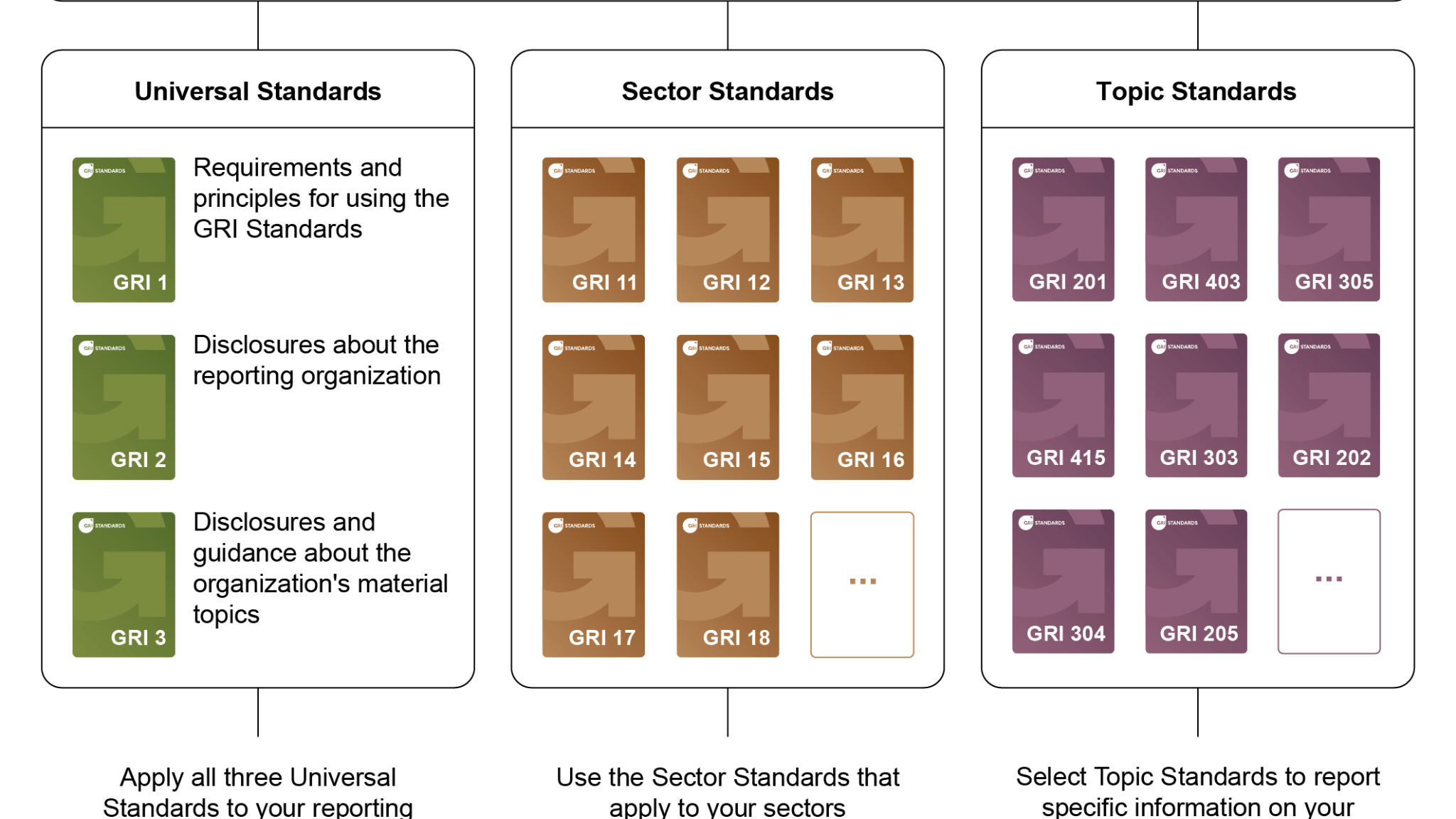
GRI reporting standards follow a modular structure. It consists of Universal, Sector, and Topic Standards. Each standard includes disclosures to direct how information should be reported. These elements form the core components of the GRI system.
1. Universal Standards
They apply to all organisations and consist of:
GRI 1: Foundation
GRI 2: General Disclosures
GRI 3: Material Topics
2. Sector Standards
These are developed for specific sectors, especially those with high impacts, such as oil and gas and agriculture. It lists likely material topics for each sector and points to corresponding disclosures in the Topic Standards. It includes sector characteristics, significant impact, and additional sector-specific disclosures.
3. Topic Standards
It contains disclosures for material sustainability topics, such as waste management, tax, and occupational health and safety. Each standard includes an overview of the topic and disclosures on how the organisation manages impacts related to that topic. Organisations select Topic Standards based on their material topics.
Materiality in GRI Standards: Focusing on the Right Topics
Materiality is essential for defining the scope of sustainability reporting. GRI defines material topics as the organisation’s most significant impacts on the economy, environment, and people, including human rights. This approach goes beyond financial materiality and focuses on the organisation’s outward impacts. All topics identified through the GRI materiality process must be reported, even if they are not considered financially material.
Steps in the GRI Materiality Process
Gain a clear understanding of the organisation’s activities, business relationships, sustainability context, and shareholders.
Identify all actual and potential impacts, including positive, negative, and short- and long-term.
Evaluate the seriousness and likelihood of the occurrence of impacts.
Combine related impacts into topics using guidance from GRI Topic and Sector Standards.
Rank topics by significance using a transparent threshold to determine the final material topics.
Who Uses GRI Standards and What Stakeholders Expect
Organisations of all sizes, sectors, locations, and types (public or private) can use the GRI Standards to disclose their most significant economic, environmental, and social impacts. They are the most widely used sustainability reporting standards globally, with 73% of the world’s 250 largest companies by revenue and many more adopting them. These standards support growing societal and stakeholder expectations for responsible and transparent business conduct.
Stakeholders
There are two types of stakeholders, mentioned as follows:
Type of Stakeholders | Stakeholder Categories |
|---|---|
Internal Stakeholders | • Employees |
External Stakeholders | • Customers |
Stakeholders Expectations
Clear understanding of the organisation’s impact on people, the environment, and the economy
Transparency for investment decisions, risk assessment, and supplier selection
Accountability, trustworthy reporting, and information to support policies, benchmarking, and community expectations
Reporting that reflects their information needs through stakeholder inclusiveness.
Turning GRI Standards Data into Decisions: The Role of Technology

Technology is playing a crucial role in meeting the updated requirements for GRI reporting. Here is how it assists:
Automates data collection: Real-time data from smart meters, Internet of Things (IoT) sensors, and APIs reduces manual errors.
Automates workflow: Software templates ensure standard alignment and faster reporting.
Offers better analysis: Artificial Intelligence (AI) and Machine Learning (ML) help identify trends, anomalies, and opportunities for improvement.
Generates quality reports: Technology enables visual, digital-first, and dynamic reports.
Improves Security: Strengthens data accuracy, integrity, and audit-readiness.
With the increasing complexity of sustainability reporting, tools like Oren Sustainability Hub have emerged to simplify the process. This platform, awarded the Best ESG Tech Platform, integrates all aspects of ESG reporting, from GHG accounting to supply chain sustainability. Such tools are particularly valuable for companies in India, where ESG reporting is becoming more prevalent.
Conclusion
The GRI Standards have become an important part of how companies around the world communicate their sustainability efforts. They help organisations focus on material impacts, stakeholder expectations, and alignment with global goals like the SDGs. With technology making data collection smoother and more reliable, reporting has also become faster and more accurate.
The boards and CXOs must lead by integrating these standards into strategy and developing a roadmap, investing in digital tools, and prioritising stakeholder transparency. It can help organisations better manage their environmental and social responsibilities, ultimately leading to a more sustainable future.
If your organisation is looking to implement GRI standards, we can help you. At Oren, we help navigate ESG complexities and regulations, provide expert support throughout the reporting process, and assist with AI-powered digital platform.
FAQs
1. What are the common challenges companies face when implementing the GRI Standards?
The challenges faced during the implementation of the GRI Standards generally include:
Gathering comprehensive and consistent data
Ensuring data accuracy and reliability
Limited time, budget, and skilled personnel
Complexity of GRI standards implementation
Identifying the most relevant ESG topics
2. Do GRI Standards require external assurance of the sustainability report?
No, GRI Standards do not mandate external assurance for sustainability reports. However, they recommend it to enhance credibility. It also builds trust with stakeholders, enhances brand reputation, and improves stakeholder relations.
3. Can small and mid-sized companies use GRI reporting standards?
Yes, small and mid-sized companies can use GRI reporting standards to demonstrate their commitment to sustainability. The standards are designed to be flexible and accessible, allowing organisations of all sizes to report their impacts transparently.
4. How often are the GRI Standards updated?
GRI Standards are updated every three years through a new work programme established by the Global Sustainability Standards Board (GSSB). However, individual standards are updated more frequently depending on the specific needs.
5. Is reporting under the GRI Standards compulsory?
No, reporting under the GRI Standards is voluntary and not compulsory. However, GRI reporting helps attract stakeholders like investors or partners to use the standards. Certain regional regulations also require using the GRI Standards.

About the author
Olivia Paul
ESG & Sustainability Advisor
Olivia is an ESG & Sustainability Advisor at Oren, focused on ESG reporting and strategy, materiality assessments, GHG inventory, and net-zero roadmaps across manufacturing, financial services, and infrastructure.