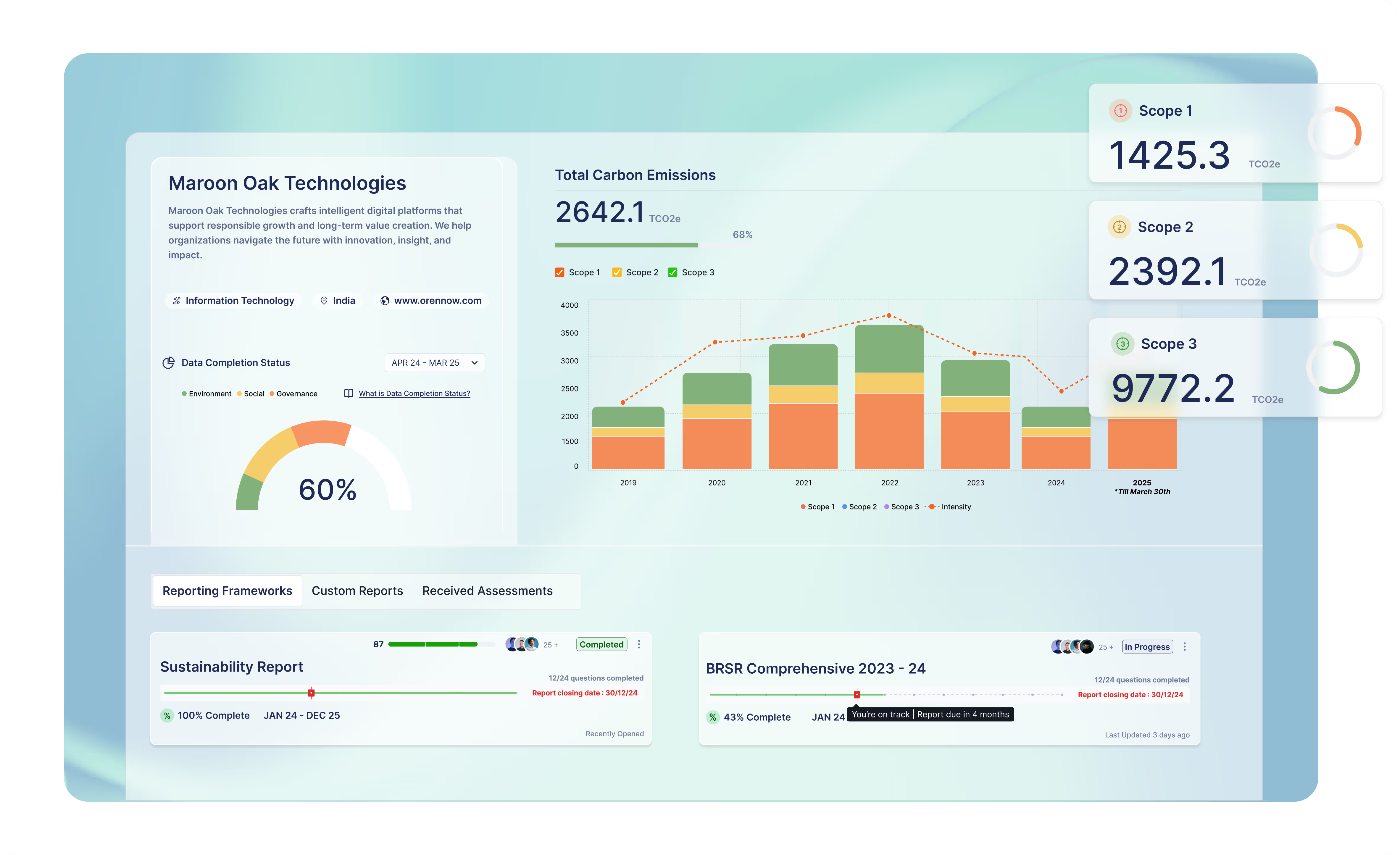
Scope 1, 2 & 3 Emissions Linking Data To Real World Action
Scope 1, 2, & 3 emissions explained for business with examples, key differences, carbon emissions reporting essentials, and a look at the future outlook for companies.
The Corporate Sustainability Reporting Directive (CSRD) sets a new benchmark for sustainability transparency and accountability across the European Union. It provides companies with a robust and standardised CSRD framework to manage CSRD reporting on environmental, social, and governance (ESG) impacts, risks, and opportunities in line with CSRD standards and the European Sustainability Reporting Standards (ESRS).
By adopting CSRD reporting, organisations can embed sustainability into their core strategy, meet evolving CSRD reporting requirements, and strengthen CSRD compliance with EU regulations. The directive enables businesses to disclose comprehensive, comparable, and reliable ESG data—supporting informed decision-making, improving CSRD ratings, and demonstrating leadership in sustainable business practices.



























Get started quickly with our pre-configured template aligned with CSRD standards and ESRS, enabling efficient and accurate CSRD ESG reporting.
Automatically map internal data to relevant ESRS and CSRD reporting requirements, simplifying data preparation and supporting double materiality assessments within the CSRD framework.
Enhance the quality and completeness of your CSRD reporting by benchmarking disclosures against industry peers, best practices, and regulatory expectations under the Corporate Sustainability Reporting Directive.
Generate high-quality, credible CSRD integrated reporting outputs that are assurance-ready, ensuring transparency, audit readiness, and alignment with CSRD compliance solutions.
Our AI-driven CSRD solution helps organisations meet all CSRD compliance and disclosure requirements by automating data collection, reporting workflows, and system integration—while strengthening ESG performance tracking.
Automate ESG data workflows to ensure accurate, consistent, and scalable CSRD ESG reporting aligned with CSRD standards and regulatory expectations.
Integrate sustainability and financial data seamlessly to support CSRD integrated reporting, enabling real-time collaboration across teams for a unified and efficient reporting process.
Your company has reported Scope 1 and Scope 2 emissions for the past three years, achieving an 8% year-over-year reduction in combined emissions. Scope 3 data coverage has expanded to include upstream transportation and business travel categories.
Collaborators from these units have contributed data, highlighting efforts to optimize energy consumption across manufacturing facilities and corporate offices, with notable improvements in renewable energy adoption.
To further accelerate emissions reduction, your company can explore supplier engagement programs and set science-based targets aligned with the Paris Agreement to strengthen overall climate strategy.
From double materiality assessments to gap analysis and data governance, our SaaS platform—combined with expert CSRD services—helps organisations stay ahead of regulatory change, ensuring full CSRD compliance while advancing long-term business sustainability.
Conduct flexible double materiality assessments and identify disclosure gaps to meet EFRAG guidance and evolving CSRD reporting requirements.
Centralize ESG and financial data in one platform to support consistent CSRD reporting, improve data quality, and maintain alignment across global sustainability standards.

“Oren is very professional, and they deliver their services and commitments in a time-bound manner. The products they have developed are absolutely topnotch and it caters to all our requirements.”


“Oren's technology and expert advisory helped us overcome data management hurdles and navigate stakeholder engagement, materiality assessment and quantifying environmental impact to publish our first BRSR report.”


“Oren immensely helped us with our Scope 1 and Scope 2 reporting. Overall, the team is well updated and very supportive - and they were always just a call away. I definitely recommend Oren to anyone who is looking for assistance in their ESG journey.”


“Oren's expertise has been instrumental in driving our ESG achievements, consistently guiding us with professionalism, reliability, and timely execution. Their outstanding products not only surpassed expectations but also fully complied with Metrochem API Industries' ESG standards.”

“Oren is very professional, and they deliver their services and commitments in a time-bound manner. The products they have developed are absolutely topnotch and it caters to all our requirements.”
“Oren's technology and expert advisory helped us overcome data management hurdles and navigate stakeholder engagement, materiality assessment and quantifying environmental impact to publish our first BRSR report.”
“Oren immensely helped us with our Scope 1 and Scope 2 reporting. Overall, the team is well updated and very supportive - and they were always just a call away. I definitely recommend Oren to anyone who is looking for assistance in their ESG journey.”
“Oren's expertise has been instrumental in driving our ESG achievements, consistently guiding us with professionalism, reliability, and timely execution. Their outstanding products not only surpassed expectations but also fully complied with Metrochem API Industries' ESG standards.”
The Corporate Sustainability Reporting Directive (CSRD) is a European Union (EU) directive that enhances and expands the existing rules on non-financial reporting. It aims to ensure that companies provide consistent, comparable, and reliable information on environmental, social, and governance (ESG) matters, thereby improving transparency for investors and other stakeholders.
The CSRD applies to large companies that meet at least two of the following criteria: More than 250 employees, Net turnover exceeding €40 million, Total assets over €20 million. Additionally, all companies listed on EU regulated markets, except micro-enterprises, are subject to the CSRD. Notably, recent proposals suggest raising the employee threshold to over 1,000, effectively reducing the number of companies required to report under the CSRD.
Companies are required to report on a broad range of sustainability topics, including: Environmental matters (e.g., climate change mitigation, resource use), Social and employee-related aspects (e.g., working conditions, diversity), Human rights, Anti-corruption and bribery, Governance factors. The disclosures should cover both the impacts of these factors on the company and the company’s impact on these factors, following the principle of double materiality.
The CSRD requirements are being implemented in phases, to ease the process of reporting: FY 2024-25: Reporting for large companies already subject to the Non-Financial Reporting Directive (NFRD). FY 2025-26: Reporting for large companies not previously subject to the NFRD. FY 2026-27: Reporting for listed small and medium-sized enterprises (SMEs), small and non-complex credit institutions, and captive insurance undertakings. However, recent developments indicate a potential delay in the start date for certain obligations to mid-2028.
Yes, non-EU companies with substantial activities in the EU are subject to the CSRD. Specifically, companies generating a net turnover of more than €150 million in the EU and having at least one subsidiary or branch in the EU meeting certain criteria will need to comply with the CSRD requirements.
The ESRS are a set of standards developed to specify the sustainability information that companies need to report under the CSRD. They aim to ensure that the reported information is comprehensive, relevant, and comparable across companies and sectors.
Yes, the CSRD introduces a requirement for companies to obtain limited assurance over their sustainability information. This means that an independent auditor or certifier will need to verify the reported information, enhancing its reliability.
Yes, the TCFD has developed supplemental guidance for specific sectors, particularly those with significant exposure to climate-related risks and opportunities. These sectors include energy, transportation, materials and buildings, and agriculture, food, and forest products. The supplemental guidance offers additional context and suggestions tailored to these industries.
Scope 1, 2, & 3 emissions explained for business with examples, key differences, carbon emissions reporting essentials, and a look at the future outlook for companies.

Selecting the right ESG framework is essential for organisations aiming to showcase their sustainability efforts and responsible business practices. This comprehensive guide breaks down the complexities of ESG frameworks, explains their significance, and highlights popular options like BRSR, GRI, SASB, TCFD, and CSRD. It covers key factors to consider, including materiality, stakeholder expectations, industry trends, and regulatory requirements. The blog also offers actionable steps for implementation, tips on using multiple frameworks, and insights on how ESG reporting drives long-term value creation.
The Global Reporting Initiative (GRI) Standards are a critical framework for sustainability reporting, widely used by organisations to communicate their economic, environmental, and social impacts. This blog explores the GRI’s importance, particularly in India, where ESG reporting is gaining prominence. It highlights how the GRI Standards help companies align with global guidelines like the UN SDGs and the OECD Guidelines. With Universal, Sector, and Topic Standards, the GRI framework offers a flexible yet comprehensive approach to sustainability reporting. Tools like Oren’s platform simplify ESG reporting, aiding businesses in meeting global standards and contributing to sustainability goals.

Explore environmental sustainability topics, benefits, definition, pillars, and initiatives that guide company action and drive improvement for companies and teams.